


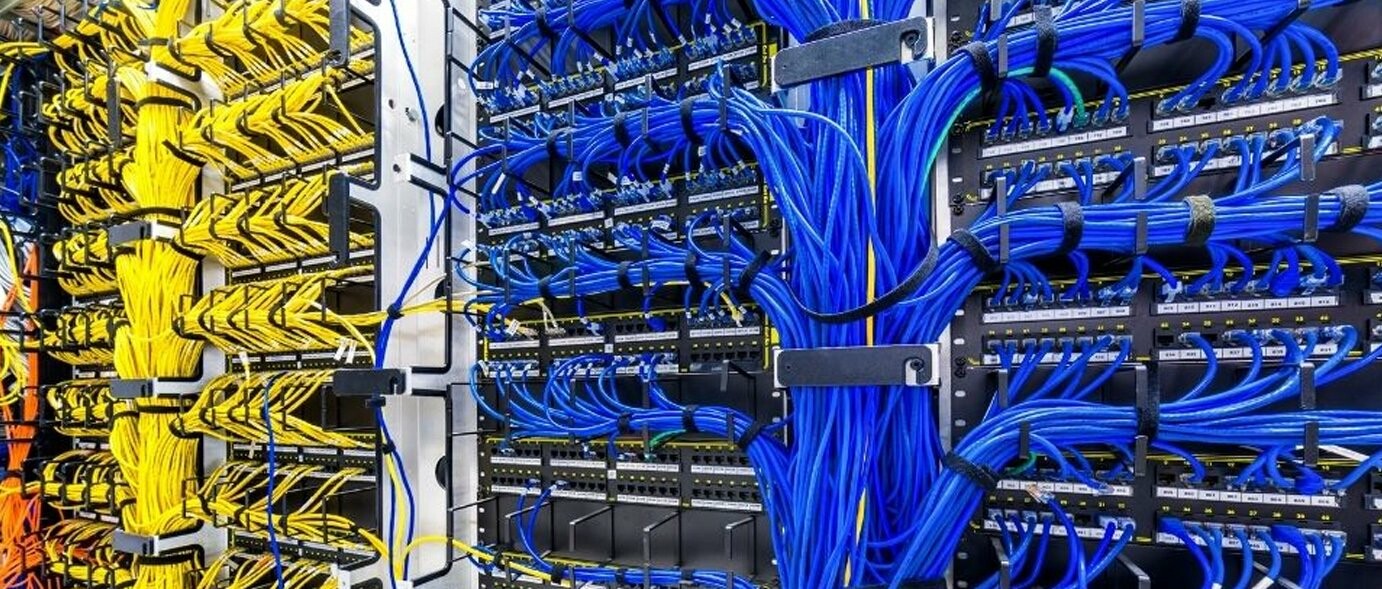
Structured Cabling System (SCS) is the foundation of a computer local area network, providing the integration of computers, telephones, servers, Wi-Fi access points, and other peripheral equipment into a single telecommunication infrastructure.
This is a universal platform for transmitting all types of signals, covering office buildings, production facilities, warehouses, workshops, data centers, and other objects. A modern SCS allows integrating local area networks, telephony, security systems, video surveillance, and automated production management into a single network.
Solution Manufacturers
Among the main vendors whose solutions are used in building SCS:

Benefits of SCS
The growing number of information services and data volumes places high demands on the reliability and flexibility of cable infrastructure. That is why SCS is the optimal solution that allows to:
- Integrate different types of information flows into a single integrated system
- Create a single physical environment for communication between different types of equipment
- Use standard wireless networks (Wi-Fi)
- Replace outdated, isolated, and poorly compatible networks built on coaxial, signal, or specialized cables
SCS Components
The system is based on:
- Copper balanced cables (categories 5e, 6, 6A, 7, 8)
- Single-mode and multi-mode fiber optic cables
The SCS also includes:
- Modular connectors
- Patch panels
- Outlets
- Splices
- Accessories for labeling, organization, and maintenance
Regulatory Standards
The design and installation of SCS are carried out following international standards:
- ANSI/TIA/EIA-568-B (USA)
- ISO/IEC IS 11801 (International)
- CENELEC EN 50173 (European)
Main Benefits for Companies
- Unification of physical infrastructure
- Compatibility of equipment from different manufacturers
- Ease of modernization and scaling
- Reduced maintenance costs
- Increased reliability and usability
Typical SCS Structure
SCS typically includes:
- Work area subsystem – provides network connection for workplaces
- Horizontal subsystem – connection between telecommunication rooms and work areas on the same floor
- Vertical (riser) subsystem – vertical connections between floors
- Telecommunication room subsystem (Data Center) – network control center
- Campus subsystem – connects several buildings in a campus
Design and Installation
The SCS design process requires high qualifications. For example:
- Vertical connections are best implemented using fiber optic cables with a fire-resistant sheath that does not emit toxic substances
- Campus connections — exclusively fiber optic, providing high bandwidth and future proofing
- Data Center connections — require the highest quality components and redundancy, as this is a critical infrastructure
Component Recommendations
- Horizontal subsystem should meet at least category 6 standards
- For new projects, it is recommended to use shielded cables of category 6A or higher, taking into account:
- The transition to Wi-Fi 6, 6E, and future Wi-Fi 7
- The growth of the PoE (Power over Ethernet) load
- High-density cable laying in trays
Work Area Subsystem
This part of the system should be designed with future growth in mind — considering the increasing number of connected devices. Modern standards recommend installing more access points in each room than before.
Reliability and Equipment Quality
One of the key benefits of SCS is a long service life (over 15 years). This is only possible provided:
- The use of high-quality, verified components
- Compliance with design and installation requirements
- Full technical support from suppliers
Unlike economy-class suppliers, who often do not ensure full compliance with standards, professional manufacturers and distributors participate in the entire project lifecycle — from concept to certification, training, and supporting designers, integrators, and customers.
This approach requires a high level of competence, but guarantees high-quality project implementation and effective system functioning in the long term.