


A mobile device has been developed to measure the pressure curve for reusable mortar equipment (as well as for recoilless guns), allowing pressure measurement in ballistic installations in the ranges of 1000 bar, 2000 bar, 3000 bar, and 5000 bar.
The device is designed as an alternative to mechanical crushers for use in recoilless ballistic installations of 82 mm and 120 mm calibers.
The device allows analyzing not only a single pressure value (like in mechanical crushers), but a dynamic curve of pressure change in the barrel bore.
The device is a data acquisition system controller to which up to 4 pressure sensors can be connected via cables up to 75 m long. The controller is mounted in a mobile case equipped with an uninterruptible power supply with batteries and a switch / router for operation in a local network.
The device can be equipped with an objective control system consisting of 2 to 4 cameras with a frequency of up to 200 frames/s and a video recording unit with the possibility of remote monitoring of the combat crew's work and recording the behavior of the ammunition after exiting the barrel.
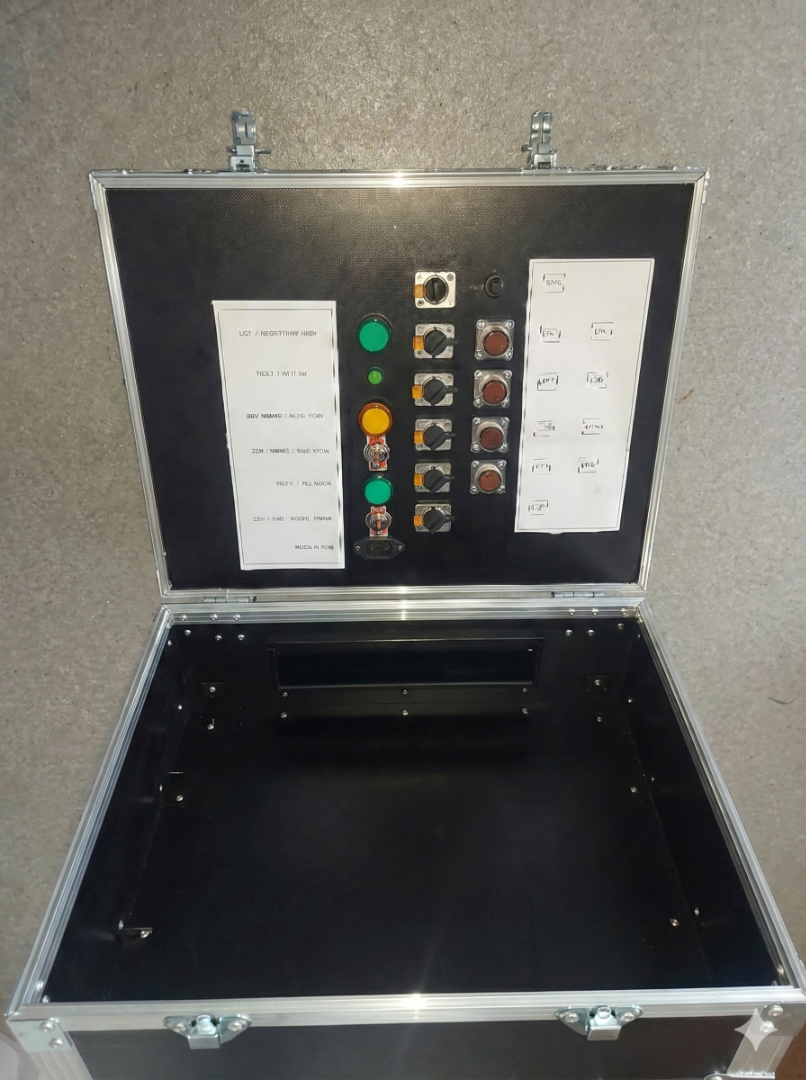
Main specifications:
- Number of sensors — up to 4
- Measured pressure range — from 100 bar to 2000 bar (up to 5000 bar)
- Deviation of the measurement curve from linear — 0.2%
- Accuracy class — 0.2
- Operating temperature range — from −40 to +100 °C
- "Zero drift" in the operating temperature range — 0.2%
- Execution class — IP67
- Standard connecting thread — M12×1.5 (or via an appropriate adapter)
- Type of connection circuit to ADC — full-bridge
Measuring controller with power supply unit:
- Number of channels — 4
- Signal sampling rate — up to 40 kHz
- ADC resolution — 26 bits
- Power supply — 24 V DC
- Filter types — Bessel, Butterworth, linear phase 0.01…7.770 (−3 dB), filter OFF
- Data transmission channel — 10Base-T / 100Base-TX
- Protocol / addressing — TCP/IP (static IP / DHCP, IPv4 / IPv6)
- Operating temperature range — from −20 to +65 °C
Synchronization of recording start:
A) from the operator's external button
B) by the signal of the control PC
Typical pressure graph for a two-channel system:
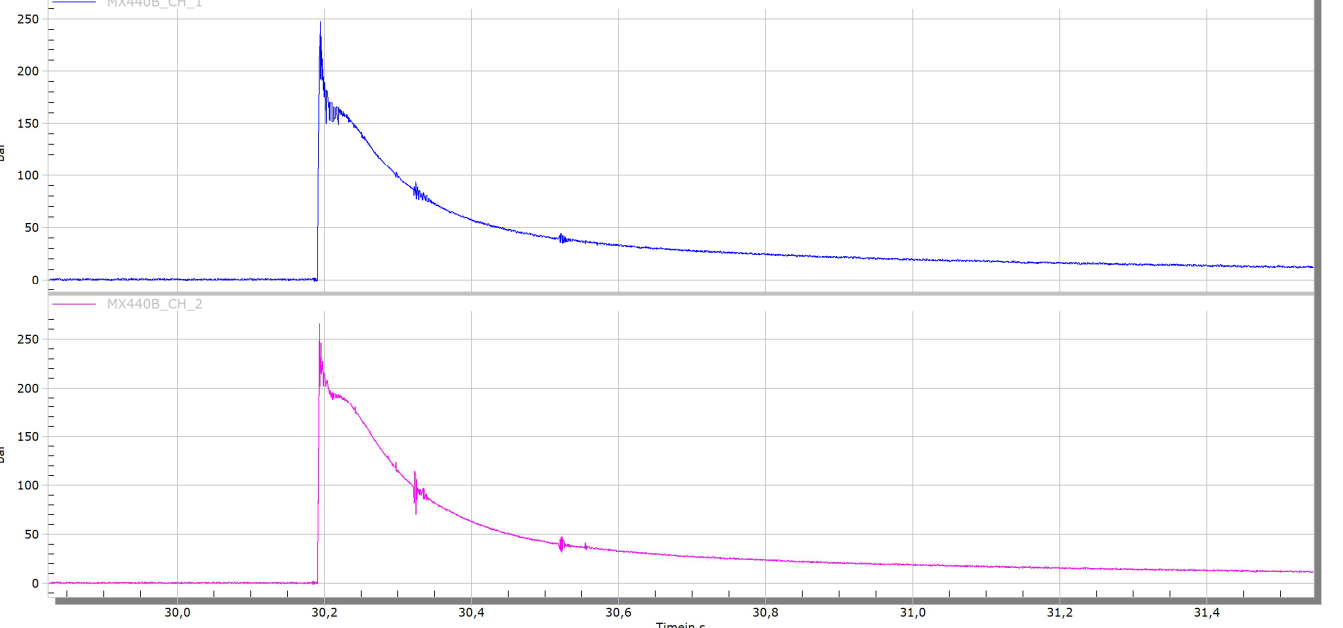
| Channel / sensor_CH_1 | Channel / sensor_CH_2 |
|---|---|
| t1: 30,184 s | t1: 30,184 s |
| t2: 30,217 s | t2: 30,217 s |
| Minimum: -1,273 bar | Minimum: -0,7895 bar |
| Maximum: 247,7 bar | Maximum: 266,0 bar |
| Mean value: 139,2 bar | Mean value: 160,2 bar |
| RMS: 156,7 bar | RMS: 180,6 bar |
Interpretation of results:
1. The pressure measurement system for ballistic equipment together with the muzzle velocity measuring device creates a powerful complex for solving the following tasks:
- measuring the dynamic pressure curve;
- analyzing the charge burning rate and evaluating its quality;
- determining and evaluating the projectile's movement time in the barrel bore and measuring the initial velocity of the projectile upon exiting the muzzle;
- analyzing the dependence of the muzzle velocity on dynamic pressure;
- evaluating the quality of the barrel and the degree of its wear (data for assessing bore erosion and barrel category).
2. Typical values for mortar equipment: the leading edge (pressure rise rate) ranges from 3 to 5 ms (0.003–0.005 s), the decline to the "plateau" of the average value is from 8 to 15 ms, the pressure drop from the maximum level to the level of 0.3 of the maximum is 180–220 ms, and to the level of 0.1 of the maximum is up to 500–700 ms. The values differ for various types of charges. After 100–120 ms, additional pressure excitations are observed, associated with the movement of the mortar bomb in the barrel bore, which creates a certain turbulence and pressure fluctuations. The peak pressure surge at the beginning of charge burning indicates an uneven burning rate and the need to improve the practice of selecting powders for forming charges 0, 1, 2, 3 (or equivalent), which also indicates the need for additional studies of the physical and chemical burning properties of powders before forming "bundles" for mortar bombs using high-pressure calorimeters (calorimetric "bombs").
3. The pressure values in the "plateau" region on average correspond to the values obtained during measurements with a classic crusher device.
The "crusher" pressure value is the integral of the pressure value over time from the beginning of burning to the moment the projectile exits the barrel.
The deviations of the values obtained from the piezoelectric sensors and from the crusher device are related to the following:
A) the piezoelectric sensor has a high measurement rate — 40 thousand times per second, meaning its inertia is very low (the time constant for P3Mb sensors is 0.00001 s), so it shows all pressure peaks and fluctuations;
B) the copper column of the crusher device has a certain inertia due to its physical properties and cannot provide the pressure change curve — only an average value, which is considered the maximum according to the classic methodology.